Updated 28 September 2026: added the transparency obligations applicable since 2 August 2026 and the new deadlines introduced by Regulation (EU) 2026/1744, in force since 27 July 2026. The tooling landscape described below remains the one observed in March 2026.
Everyone's talking about AI agents in 2026. Anthropic launched Claude Cowork with 11 enterprise plugins. OpenAI pushed Frontier for building agents. Every SaaS tool added "agentic" to their marketing page. Gartner says 80%+ of enterprises will run agentic AI in production by end of 2026.
But here's the number nobody talks about: Gartner also predicts more than 40% of AI agent projects will be canceled by 2027 because teams misjudged the effort, overestimated the impact, or skipped basic oversight.
So what actually works for a small business? Let's cut through the noise.
What Is an AI Agent (In Plain English)?
A regular AI chatbot answers questions. An AI agent does things.
It can read your emails, draft responses, update your CRM, generate invoices, route support tickets - without you clicking buttons. Think of it as an employee that follows instructions perfectly, works 24/7, never forgets, and costs a fraction of a salary.
But - and this matters - it also doesn't understand context the way humans do. It will follow bad instructions just as faithfully as good ones. Give it a sloppy process and you'll get sloppy results at machine speed.
The key difference from traditional automation (like Zapier or IFTTT) is that agents can handle variability. A classic automation breaks when an invoice has a different format. An AI agent reads the invoice like a human would and figures out where the total is, even if it's in a different spot.
Source: MIT Sloan - Agentic AI Explained
The Race: Claude vs ChatGPT vs Everyone Else
This is where things get interesting.
According to the Menlo Ventures December 2025 survey, Anthropic's Claude now commands 40% of enterprise LLM spending - up from 12% in 2023. OpenAI dropped from 50% to 27%. That's a massive shift in less than two years.
Two launches shaped early 2026:
Claude Cowork dropped on January 30, 2026. It's a no-code agentic assistant with 11 plugins for enterprise workflows. The pitch: non-technical people can build agents that actually do useful work. Connect your tools, describe what you want, and the agent handles it.
OpenAI's Frontier takes a different approach. It's more developer-focused, letting companies build custom agents within their own infrastructure. More power, more complexity.
On raw performance, Claude Opus 4.6 outperformed GPT-5.2 by 144 Elo points on GDPval-AA - a benchmark that tests professional tasks in finance and law. Anthropic also owns 54% of the enterprise coding market.
The real strategic split is clear. OpenAI is becoming a consumer "super-app" - travel booking, shopping, food ordering. Anthropic is doubling down on professional infrastructure - financial terminals, developer tools, enterprise workflows.
chevron_rightThe OpenClaw Saga
And then there's OpenClaw. Built by Austrian developer Peter Steinberger, it went from a side project called "Clawdbot" in November 2025 to the most-starred project on GitHub (250K+ stars) by March 2026 - surpassing React. It's an open-source AI agent framework that lets you run autonomous coding and workflow agents locally.
Here's where it got messy. OpenClaw users could authenticate with their Claude Pro/Max subscriptions via OAuth, effectively running unlimited agentic workloads at a flat monthly price. A $200/month Claude Max subscription becomes deeply unprofitable when someone runs 24/7 autonomous agents through it.
In January 2026, Anthropic silently blocked OAuth tokens from working in third-party tools like OpenClaw. Users got banned without warning. The developer community was furious - not about the policy itself, but about the silent rollout. Anthropic only published formal documentation a month later in February.
The fallout was fascinating. Steinberger joined OpenAI in February 2026. OpenClaw moved to an independent open-source foundation sponsored by OpenAI. Anthropic responded by launching Claude Code Channels (March 2026) and Claude Dispatch for Cowork - essentially building their own competing agent interfaces.
The takeaway for businesses? The agent ecosystem is in a land-grab phase. Open-source tools like OpenClaw, n8n, and commercial platforms are all racing to become the default way you interact with AI. That competition is driving prices down and capabilities up. Good for you.
What this means for you: the tools are getting better and cheaper every month. The question isn't "should I use AI" anymore. It's "where should I start?"
What Actually Works for Small Business
Here's what we're seeing deliver real results for companies with 5-50 employees:
1. Invoice and expense processing. AI reads invoices, extracts line items, matches them to purchase orders, and flags discrepancies. For a 20-person company processing 200+ invoices a month, this saves 5-10 hours per week. The error rate drops too - machines don't misread numbers when they're tired on a Friday afternoon.
2. Email triage and response drafting. An agent reads your inbox, categorizes messages by urgency and type, and drafts responses for routine items. You review and hit send. Most business owners we talk to save 1-2 hours per day. That's 5-10 hours a week you get back for actual work.
3. Client onboarding. Automated welcome sequences, document collection, account setup, and initial check-ins. What used to take 3 days of back-and-forth emails now takes 3 hours. The client experience is actually better because nothing falls through the cracks.
4. Report generation. Pull data from your CRM, accounting software, and project management tool. Format it. Send it to stakeholders. Weekly reports that took half a day to compile now take 5 minutes of review time.
5. Customer support first-line. AI handles FAQs, order status inquiries, and simple troubleshooting. Complex issues get routed to humans with full context attached. Good implementations handle 60-70% of tickets without human intervention.
The numbers back this up: 66% of small businesses using AI save between $500 and $2,000 monthly, while 58% free up over 20 hours each month. That's not theoretical - that's money back in your pocket and time back in your calendar.
What Doesn't Work (Yet)
Let's be honest about the gaps.
Anything requiring nuanced judgment or empathy. Complex negotiations, sensitive HR conversations, handling an angry client who needs to feel heard - AI is terrible at this. It can simulate empathy, but people can tell the difference.
Tasks with ambiguous instructions. "Make it better" or "use your judgment" will produce unpredictable results. Agents need clear, specific instructions. If you can't write it down step-by-step, an agent can't do it reliably.
Processes that change frequently without documentation. If your team handles things differently every week based on tribal knowledge, an agent won't keep up. You need to document the process first - which, honestly, you should do anyway.
Security-critical decisions without human oversight. Approving large payments, granting system access, making compliance decisions - keep a human in the loop. Always.
Here's the pattern we see: structured AI implementation with clear workflow mapping produces 3-4x the return of ad-hoc tool adoption. The companies that fail are the ones that throw AI at problems without thinking through the process first.
What to document before you deploy. A single system can fall under several frameworks: the GDPR if it processes personal data, copyright law if protected content is used, and the AI Act depending on your role and the system's purpose. These frameworks overlap, but their obligations are not interchangeable.
Start with a one-page inventory sheet: purpose, provider and model, people affected, data categories, content sources, retention period, internal owner, oversight, incident procedure. That sheet does not make you compliant with all three texts. It tells you which further analyses to trigger: a GDPR impact assessment if the processing carries high risk, a licence check if you reuse content.
And keep human oversight proportionate to the risk. For the ordinary use cases described above, that is good management, not a legal duty. The human oversight obligation in Article 26 targets deployers of high-risk systems, once that regime applies.
What changed legally since March
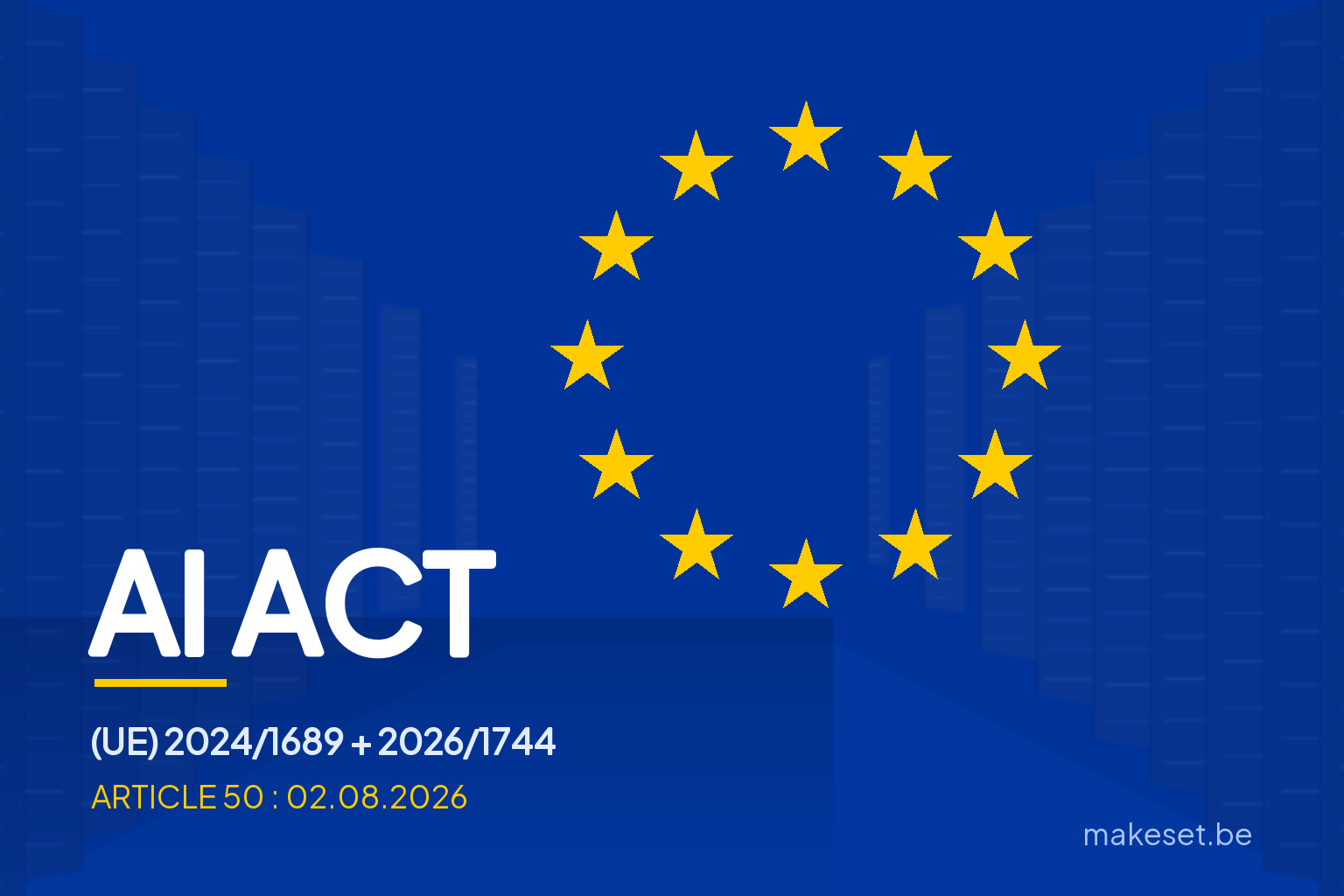
When this article was published, the AI Act was a distant deadline. Since 2 August 2026, most of the regulation applies, including the transparency obligations in Article 50. Their scope depends on your role, and that is the point most articles miss.
If you use a third-party tool, you are in principle a deployer, as long as you use it under your own authority. It is then up to the provider to design a system that tells people they are interacting with an AI, unless that is obvious from the context. Your job: check that the notice appears from the first interaction, and keep evidence that you checked.
If you have the agent built and put it into service under your own name, you are a provider, and the design obligation falls on you. Many small businesses are in that position without realising it.
For generated content, there are two separate duties. Technical marking of synthetic content falls on the system's provider. The deployer must disclose deepfakes and certain texts published to inform the public on matters of public interest. An exemption exists where the content has undergone human review and editorial control with someone taking editorial responsibility, but be careful: a quick proofread is not enough, the review must address the content substantively.
The high-risk timeline, meanwhile, has moved back. Regulation (EU) 2026/1744, in force since 27 July 2026, postpones Annex III to 2 December 2027, sixteen months, and Annex I to 2 August 2028, twelve months. For ordinary invoice processing, email triage or report generation, the high-risk regime does not apply in principle, unless the tool actually serves a listed purpose, for instance in employment, creditworthiness or access to an essential service. Purpose is what qualifies a system, not the technology.
Finally, the oldest provision is also the most overlooked: since 2 February 2025, providers and deployers must take measures to promote AI literacy, proportionate to the context and to what the people involved already know. Since 27 July 2026, the regulation clarifies that this does not require guaranteeing a specific level for every individual.
How to Start Without Wasting Money
Three steps. That's it.
- Pick ONE workflow. Choose something that's repetitive, well-documented, and eats up real time. Don't pick your most complex process. Pick the boring one that everyone hates doing. Invoice processing, data entry, appointment scheduling - something concrete.
- Build a proof of concept in 2 weeks, not 6 months. Use tools like n8n (open source workflow automation), Make.com, or Zapier for simpler flows. Connect your existing tools. Set up the agent. Test it on real data. Two weeks is enough to know if something works.
- Measure before and after. Time saved. Errors reduced. Cost impact. If you can't measure it, you can't prove it works. And if you can't prove it works, you'll never get buy-in to scale it.
Don't try to automate everything at once. That's exactly how 40% of AI agent projects end up getting canceled. Start small. Prove value. Expand.
Our Take
AI agents aren't magic. They're tools. Like any tool, they work brilliantly when used for the right job and terribly when forced into the wrong one.
The businesses that will win with AI in 2026 aren't the ones adopting the most tools. They're the ones picking the right problems, implementing carefully, and measuring results honestly.
Start small. Measure everything. Scale what works. Kill what doesn't.
chevron_rightWant to Automate the Right Things?
We build AI automation for small businesses in Brussels. Let's figure out what's worth automating.
Let's Talk